Many companies have a model that truly embodies the brand, even if it’s not a flagship product. Toyota has a Camry, Omega has a Speedmaster, and Rolex has a Datejust. It is one of the most durable models in the Rolex portfolio, featuring many iconic features: the classic Oyster case, the cyclopean lens above the date window, the (optional) fluted bezel, the Jubilee or Oyster bracelet, and the timeless, versatile aesthetic. When many people think of the quintessential Rolex style, Datejust comes to mind. First introduced in 1945, this model is a “workhorse” that continues to perfectly represent the brand with a design that complements a business suit, perfect for a weekend at the beach and any other event.
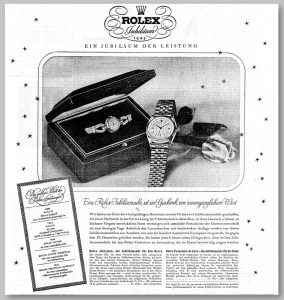
Datejust was released for the 40th anniversary of Rolex and was a real breakthrough, and since then countless brands have copied this aesthetic. Firstly, it was the first automatic clock with a date window at 3 o’clock, which automatically changed the date at midnight without unnecessary hassle. Today it is taken for granted.
It was then that the Jubilee bracelet, which became iconic, appeared, and later the cyclopean date magnification lens. Over the decades, there have been many sizes, metal combinations, and seemingly countless options for dials, so let’s focus on the basic references.
Datejust was not the first watch with date complexity. In fact, it has appeared in one form or another on pocket watches since the early 19th century, although the perpetual calendar watch created by Thomas Mudge in 1762 was probably the earliest with a date function. It is noteworthy that the repeaters and complications indicating the phases of the Moon appeared even before the date. As for wristwatches, Movado first introduced a date window on the dial (at least on the production model) in 1915, and watchmaker A. Hammerley patented a date pointer (with a day of the week window) in the same year. Mimo (Girard Perregaux) introduced the Mimo Meter in the 1930s, the first watch with a traditional date window at 3 o’clock, which further popularized this complication. However, it was Datejust that really brought the date window to the mass market thanks to the automatic date change at midnight in combination with the automatic chronometer mechanism.
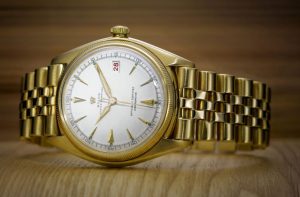
The Datejust celebrated the 40th anniversary of Rolex with a 36 mm Oyster case in 18k yellow gold, a fluted bezel and a date window at 3 o’clock (without a cyclopean lens). The watch also featured a five-row Jubilee bracelet. The relatively large Caliber 710 required a domed rear case cover (“Big Bubbleback”), which was larger and more convex than the then-common Rolex models with Bubbleback. It even got the nickname “Ovettone” (Italian for “big egg”) because the domed glass back cover resembled an egg.
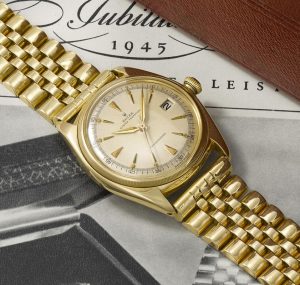
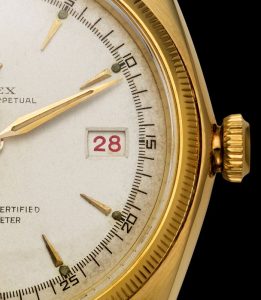
The dial featured superimposed gold pointed dagger-shaped indexes with radium dots and gold alpha hands with radium inserts (safer tritium was not yet used then). A detailed minute/second scale with Arabic numerals covered the outer perimeter, and a slanted date window was at 3 o’clock in black font. This arrangement has become a common industry standard in the future. “Datejust” was not printed on the dial, as instead “Chronometre” was located above the “6 o’clock” mark, while Rolex and Oyster Perpetual were printed below the “12 o’clock” mark with a printed crown. It took nine years before the first Datejust dials debuted around 1954 with the reference number 6105, but Datejust still described the watch in advertisements and catalogs. However, only a relatively small number of dials, starting around 1950, starting with the 5030/5031 models, had the Datejust label, but this was far from the norm. Later models of the 4467 had a dial with the inscription “Certified Chronometer” above the “6 o’clock” mark.
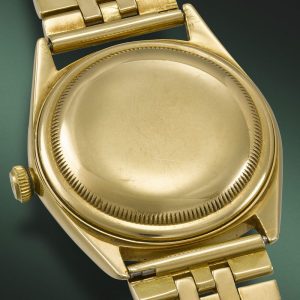
The 4467 was originally produced in a limited edition of 100 copies, and the earliest models were even sold in collaboration with the Swiss newspaper Tribune de Genève (a newspaper coupon gave the right to first choice), and the issue numbers were printed between the ears. However, Datejust was an instant success and prompted Rolex to abandon the idea of a limited edition and switch to standard production. However, only about 1,000 copies of Datejust were produced, numbered 4467.
It wasn’t a limited edition, but it wasn’t too big either. Several notable variants include a left-handed version (crown at 9 o’clock) and a rare black dial with a white date window and red font in a rose gold case, as well as non-luminescent dials. It should be noted that the white date window with red font was not limited to black dials, and virtually all dials from 1945 to 1947 had white and red date windows, following the early batches with black font. Soon, roulette—type dates with even days in red and odd days in black also became common. The Datejust’s water resistance is 100 meters from the start.
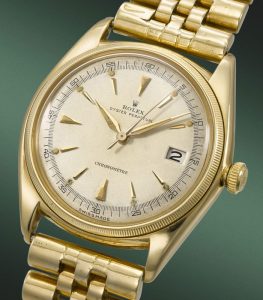
The next major models, the 5030 and 5031, were transitional models that introduced some new elements, but still retained the aesthetics of the early 4467 model. They continued to carry the nickname “Ovettone”, as the back cover with a large bubble and domed glass remained.
The new design of the Rolesor watch (a combination of gold and steel) and the all-steel case gave the watch a more casual and distinctive look, which became a hallmark of later models. The Model 5030 had a smooth bezel, while the Model 5031 had a fluted bezel, but otherwise they were the same. White and black dials were standard. The date wheels were mainly used in the form of a roulette wheel, and the cases were available in yellow or rose gold, two-tone Rolesor and stainless steel cases. Interestingly, these models had three distinctive crowns. As already mentioned, these were the first limited edition Datejust models.
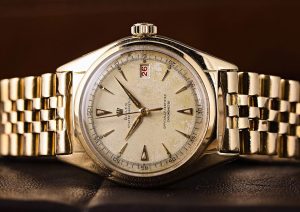
These were the latest models that fully followed the original design of the 4467, as significant changes were expected, in particular, the inscription “Datejust” on all dials and a cyclopean lens above the date indicator. The Model 6104 had a smooth bezel, while the Model 6105 had a guilloched bezel.
Datejust watches began appearing in red on some Oyster Perpetual dials and are known as the “Red Datejust” dials, and the dials were again available in cream white and black, with rare exceptions, including diamonds. Reference 6074 was an extremely rare platinum variant, and it is believed that only two such copies were produced in 1950. The printing on the dial has also undergone changes: the inscription “Swiss Made” at the bottom has changed to “Swiss”, scattered inscriptions “Officially Certified Chronometer” or “Chronometer Officially Certified” have appeared. The Rolex inscription and the crown sign were overhead, not printed, and the date window had either a red print or a roulette pattern (red and black). Metal options included yellow or rose gold, Rolesor, and an all-steel version, which later became the standard.
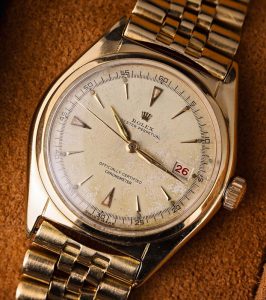
This was a very important update, as the first Cyclops magnifying lenses appeared above the date window, which later became the quintessential look for Datejust and many other Rolex models. It is noteworthy that initially not all watches were equipped with additional cyclops lenses, and customers could purchase watches with the old, standard glass without magnification. Enthusiasts often resist change at first.
The 6304 model had a smooth bezel, while the 6305 model had a fluted bezel with a design much closer to the modern fluted Datejust bezels. From that moment on, the dial options began to expand significantly, even more than those of previous models, with more colors, dial element options, and textures such as honeycombs. Modern Datejust was taking shape.
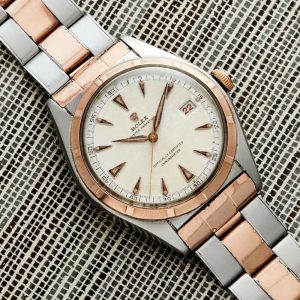
An interesting version of Datejust was released with a rotating bezel instead of a smooth, fluted or guilloched one. It was an evolution of the 1953 Turn-O-Graph, model number 6202, the first production Rolex model with a rotating bezel (only a few months ahead of the Submariner). It was a diver-style model designed only for measuring time, with a black aluminum bezel and a detailed 60-minute scale.
Probably to avoid direct competition with the new Submariner, the Turn-O-Graph was transformed into the Datejust in 1954 under the article 6309, receiving the usual date and cyclopean lens, the Datejust inscription on the dial instead of the Turn-O-Graph and a new all-metal bezel replacing the original aluminum bezel.
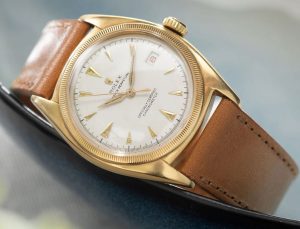
In 1953, the US Air Force created the Thunderbird Squadron, a demonstration air group similar to the Blue Angels of the US Navy (formed in 1946). According to reports, the Thunderbird pilot had a Datejust Turn-O-Graph navigation device installed, which quickly became popular among pilots. Rolex has also started selling gold versions called “Datejust Thunderbird” in the American market. A special series of 18-carat gold watches with the Thunderbird logo on the dial was also released. Datejust Thunderbird watches received many mentions and updates and were released until 2011 under the numbers 116264 (steel with white gold bezel) and 116263 (Rolesor).
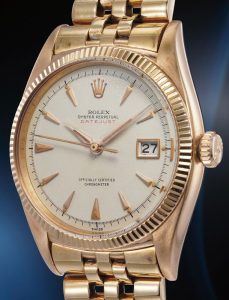
This model is best known for its thinner body. The Ovettone’s design has been replaced with a flatter and more modern one thanks to the new improved 1065 Caliber. An instant date change at midnight has also been introduced, but the quick date setting feature has not yet been implemented. The Model 6604 had a smooth bezel, while the Model 6605 had a fluted bezel.
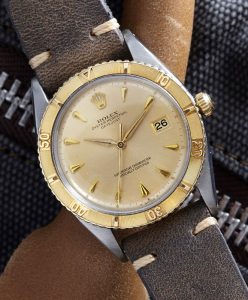
In the early years, in 1957, a smaller version of Lady Datejust was introduced. The 26 mm case was almost identical to the men’s 36 mm version and was a suitable model for women, especially in an era when they mostly wore watches with a diameter of less than 30 mm. It wasn’t until 2015 that Lady Datejust increased slightly to 28 mm. In the 1960s, a medium-sized Datejust watch with a 31 mm case was released: a small model for men and a fairly large model for women.
The mechanisms for them, as a rule, were the same as those of Lady Datejust. Between the 31mm and 36mm Datejust watches, there was a Rolex Date watch with a 34mm case, introduced in the 1950s. It was a separate model, but it shared the aesthetics and functions of Datejust, although it traditionally had a smooth bezel and Oyster bracelet, unlike Datejust’s usual fluted bezel and Jubilee bracelet.
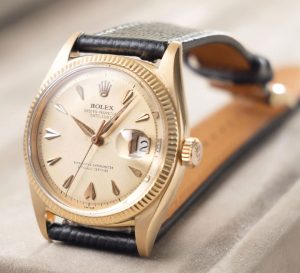
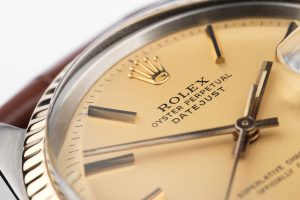
Pie-shaped dials were popular in older Datejust models from the 1950s to the 1970s, with a recessed outer edge resembling an inverted pie pan. They were also used in early Day Date models. The classic 1960 Datejust watch, Reference 1601, is perhaps the most famous example, as it was a model with a long service life that was discontinued in 1981. Models such as the 5030/5031 also had pie-shaped dials. In the later 1601 models, the design was abolished. This particular model is ubiquitous (for Datejust) and is great for enthusiasts who are looking for an affordable vintage option in the used watch market.
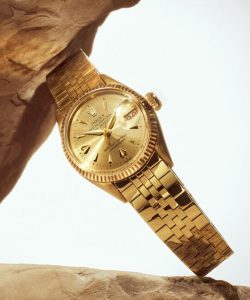
These watches have probably been produced since 1959, but it is generally assumed that they appeared in 1960. Over the more than 20 years of its existence, the model has undergone many changes, but it is undoubtedly one of the greatest classic Datejust models that can be easily found on the used watch market. Initially, the watch had outdated functions, but soon underwent changes in a more modern design with stick-shaped hands and hour indexes, which remain to this day. Of course, there were many dial options, but the later 1601 models followed the “finalized” Datejust formula, and a good second-hand model with a fluted bezel and an anniversary bracelet would really look like the new 36mm modern model.
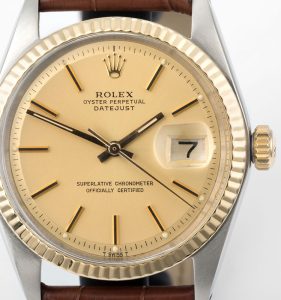
Early 1601 models were equipped with the 1565 Caliber (manufactured by Aegler) with a 42-hour power reserve and a frequency of 18,000 vibrations per hour. There was no quick date setting function, but the watch had increased impact resistance and was generally very reliable. This was quite enough for early models, but the later Calibre 1575, released in 1965, increased the frequency to 19,800 half-vibrations per hour and added the stop function of the second hand in 1972. For Rolex at that time, many mechanisms were labeled as 1560 or 1570, because instead of individual caliber numbers, they used engraved plates for the entire family of mechanisms.
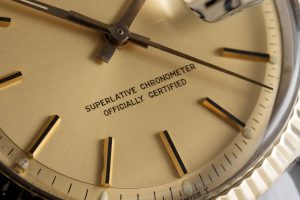
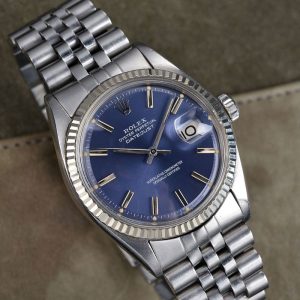
A significant change in the first five-digit Datejust models was the Caliber 3035, which finally received a quick date setting feature, so that the date wheel could be easily adjusted using the crown, rather than rotating the central hands indefinitely. Aesthetically, it was a technical and transitional model, which to some extent echoed the later models of 1601. Vintage elements such as acrylic glass and drilled arches were preserved in this model, and it often had a steel bezel processed in a guilloched manner. However, in this generation, the circular bowl dials were replaced by flat, modern counterparts. The Reference 16013 was a classic Rolesor model with a fluted bezel.
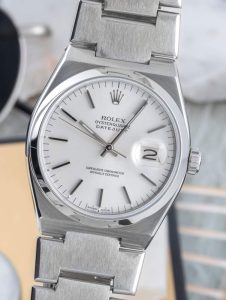
Rolex developed its own quartz movements in response to the quartz crisis (started by Seiko in 1969). The model followed the 1970 Rolex Beta 21 (ref. 5100) model with a Swiss-made quartz movement by Centre Electronique Horloger (CEH), the fruit of the collaboration of about 20 Swiss watch companies such as Patek Philippe, Omega and Piaget. Interestingly, this was the first Rolex watch with a sapphire crystal (even before Day-Date began to use it).
The first Oysterquartz Datejust watches debuted in 1977 with quartz movement
alibrum 5035, a manufactured movement that existed alongside the quartz Calibre 5055 in the Oysterquartz Day-Date model. The Reference 17000 is an Oysterquartz Datejust steel watch. The 17013 model was a two-color analog. All Rolex Oysterquartz models had a distinctive case with a more angular design and an integrated bracelet, which distinguished them from standard mechanical collections. The original Beta 21 had a similar design, but with a larger 39mm case to accommodate most of the early quartz movement. All Oysterquartz models were discontinued by 2004, but for those who appreciate the style and exceptional precision provided by quartz, many second-hand copies are available.
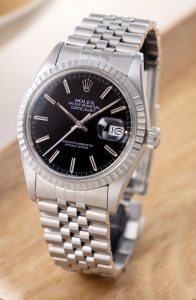
The Datejust model was equipped with a new 3135 caliber mechanism, but only minor technical improvements made it a little more accurate and reliable. The model was equipped with a heat-resistant Rolex balance wheel with Microstella adjusting screws and a patented anti-magnetic and shock-resistant Parachrom balance spiral. However, the main change in this model was the transition from acrylic glass to sapphire glass, which was the final touch that brought Datejust into the modern era. Aesthetically, little has changed, except for the usual variety of dial options combined with various bezels and two types of bracelets (Oyster or Jubilee).
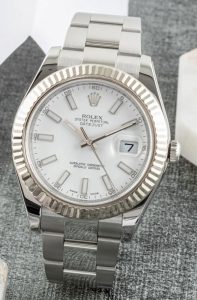
The biggest change in the design of the Datejust occurred in 2009 with the Datejust II, the first model to have its case diameter increased from 36 mm to 41 mm – a very important and controversial event at the time for such a conservative watch manufacturer, true to tradition and, as a rule, opposed to such changes. The building has become not only bigger, but also bolder. The ears and bezel are now thicker and wider than the case (compared to the 36mm models), following an industry trend and targeting buyers who prefer larger watches.

36 mm cases today certainly occupy a smaller part of the men’s collection, reflecting the changing tastes over the past decades. The new model received a new movement, the 3136 caliber, although the changes compared to the previous 3135 caliber were relatively minor. The Reference 116300 was a stainless steel model with a smooth bezel, while the reference 116334 was a steel model with a fluted white gold bezel. It is noteworthy that the Datejust II watch was supplied only with an Oyster bracelet, despite the fluted bezel, which is traditionally combined with Jubilee watches. This was probably due to the ease of production for a larger body (and cost savings). There were many other options in the Datejust II collection, including dial and metal options.
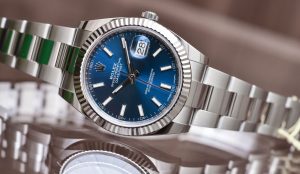
Rolex has learned from its experiment with the Datejust II and made some changes, while maintaining a larger case size of 41 mm. First, the Jubilee bracelet returned with the Oyster, and the overall proportions were softened to match the 36mm case (thinner ears and a narrower bezel).
This model found a greater response from customers because it combined a classic style with a more modern size. The Datejust 41 has a Calibre of 3235, an excellent chronometer with a modern Chronergy trigger and a running accuracy of +/-2 seconds per day, which fully meets the general requirements of COSC – -4/+6 seconds per day. This was the last innovation until the debut of the 7135 Dynapulse trigger mechanism featured in the 2025 Rolex Land Dweller watch. The stainless steel model 126300 had a smooth bezel, while the model 126334 had a fluted white gold bezel. Traditionally, there are many variations in this collection.
Today, Datejust watches are available in four case sizes: the Lady-Datejust 28 mm, the medium-sized 31 mm model (or the larger female model), the traditional 36 mm model, and the Datejust 41 mm. As already mentioned, Datejust is the perfect embodiment of the brand, and now they have a size for every taste. It’s not the most eye-catching or prestigious model, but it’s one of the most recognizable Rolex designs that other watch manufacturers have copied for decades.
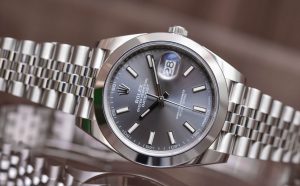
The design of Datejust is timeless, and the models of past decades are very similar to modern ones. This is not an elegant Day-Date or an attempt to create a casual image like the Submariner or Deepsea. This is probably the best way to show off class and style without bragging about wealth or wanting to look like James Bond. The most interesting thing is the vintage counterparts. The 16030 models can be found for less than $5,000, while the 16234 models with the new sapphire crystal can be purchased for about $6,000.
Rare models such as the 1601 with the “Confetti” dial are in great demand due to their unique and colorful pattern, ranging from 8,000 US dollars (and up to 15,000 US dollars for gold copies). Surprisingly, Oysterquartz Datejusts watches are very interesting to collect, as they were released in relatively limited quantities and are a rarity in the general collection.
Oysterquartz copies, even Rolesor models like the 17013, can be found for less than $6,000, because it is a stylish collectible Rolex for a wide range of connoisseurs. Whichever model you choose, vintage or modern, with a fluted, smooth or guilloched bezel, an Oyster or Jubilee bracelet, a traditional or stylized dial, an automatic or quartz movement, with Datejust you will get the quintessence of Rolex.
- A. Lange & Söhne
- Audemars Piguet
- Blancpain
- Bovet
- Bovet
- Breguet
- Breitling
- Bvlgari
- Cartier
- Chanel
- Chopard
- Damiani
- De Bethune
- De Grisogono
- Diamond
- F.P. Journe
- Frederique Constant
- Gerald Genta
- Girard-Perregaux
- Greubel
- Harry Winston
- Hublot
- IWC
- Jacob & Co.
- Jaeger-LeCoultre
- Louis Moinet
- Omega
- Panerai
- Parmigiani
- Patek Philippe
- Piaget
- Richard Mille
- Roger Dubuis
- Rolex
- TAG Heuer
- Ulysse Nardin
- Vacheron Constantin
- Vacheron Constantin
- Van Cleef & Arpels
- Zenith
- Reviews